Wednesday, July 27, 2011

Misty Morning Road from Laputa to Market


Today's blog covers last Saturday's return from Laputa in the early misty morning.  Friday we had driven to Mwene-Ditu for missionary interviews then on to Laputa.  The road from Mbuji-Mayi to Mwene-Ditu is paved but badly chuck-holed.  It dates from the 1960's.  From Mwene-Ditu to Laputa is dirt.  Since it is now the dry season we only had to deal with dust and bad ruts.  The big trucks drive right down the middle leaving big ruts.   Driving too close to the sides could cause a tip-over.

Saturday morning we awoke to heavy mist.     


People live along the road amid palm trees.  These palms produce palm nuts for making palm oil. Our driver said that few people live away from the road and where water is available.  Thus there are miles and miles of virtually uninhabited areas.   


The houses all look neat.  In the cities there is trash everywhere.  


A roadside stand selling beans (I think).  Notice the woman is wrapped up against the morning chill.  Who would have expected chilly weather in the Congo?


Now for the road.  This is indeed the national highway from the capital Kinshasa in the north to Lubumbashi in the south.  During the rainy season it is virtually impassable.  Very seldom are the roads bulldozed flat so deep swells develop from the big trucks.  When it rains it's difficult to gage the depth of the puddles.  Put the truck in 4-wheel drive, reve up the engine, follow the tracks and pray.


Two months ago we had to stop and with shovel fill in some ruts on this hill.  The photos don't show the roughness of the road.  


Transporting loads on big trucks is very expensive.  It's cost effective to put loads on bicycles and transport corn or fish or flour along the dusty roads.  Thieves and brigands are not a problem.  The men push all day, stopping to eat at roadside restaurants and sleeping in the tall grass at night.


This man may have a heavy load of dried fish bought at a cheap price in Lubumbashi for sale in Mbuji-Mayi for a good profit.  The cost:  a month of drudgery along the 1000 kilometer road.  It's not flat.  There are hills and ruts and rocks and dust.  The men are wiry.


The loads are too big to allow biking.


Several months on the road.  The driver said they were Kasai people from the Mbuji-Mayi region.  When the Belgians were in the Congo, they recruited the Kasai to work the mines in Lubumbashi.  In the 1960's, the people of Lubumbashi persecuted these industrious Kasai, killing many and driving the rest back north.  That's why the village of Laputa has a Stake of Zion and over 2000 members of the Church.  They joined the Church in the south but were driven north as refugees.  


To market swinging her arms goes this woman with a heavy basket of cassava roots on her head.  The roots will be prepared and then ground into flour to make Fou-fou, the stable food of the Congo.


Vegetables to market.  We eat this once a week.  A strong spinach type flavor.


Looks like cabbages.  The women carry heavy things on their head.  The men push heavy loads.  

It's a hard life here.  


Thursday, July 21, 2011

Daughters of Helaman


Daughters of Helaman

The scriptures and sacrament meeting talks have a lot to say about the Sons of Helaman.  Deseret Book and Seagull Book are big on T-shirts with Sons of Helaman logos.  But what of the daughters?  Well, we met some of the daughters this past week.  They were starting their missions from their homes in Laputa.  

None of them were born in Laputa.  They are the children of refugees who fled Lubumbashi and Katanga Province during the revolution in the 60's.  They are the Anti-Lehi-Nephi's of the Congo.  Now they will bless their country, though at one time they were not wanted.  The Book of Mormon is a type for our day.  Read it carefully to see the other parallels for the Last Days.   

Nine new missionaries left Laputa last Friday on their way to Kinshasa for shots, passports and visas before going to Ghana and the MTC.  Half way here they learned that their flights had been canceled.  It being impossible to return home, they continued here.  (The airline had been closed by the government after the disastrous crash at Disangani.  Apparently tower error in inclement weather.  Due to the poor airport lighting Congolese planes don't fly at night.)  They arrived in Mbuji-Mayi at 10 p.m.  The 4 elders were housed with our 8 full-time elders at the missionary apartment.  The 5 sisters came to our home and were housed in the 2 upstairs apartments, arriving at 11 p.m.  

For breakfast we fed them what we had: cut-up fruit, yogurt and round buns.  Despite having never eaten yogurt, they did pretty well but didn't grasp the concept of putting fruit on the yogurt.  The buns they broke into pieces with their hands
Lunch

 Although Congolese don't usually eat lunch, we tried to feed them sandwiches made with canned beef.  We made the  mistake of just putting the mayonnaise on the table which they layered think.  Surprisingly, they didn't seem to like the beef.  However half the butter disappeared in thick chunks.  No doubt they all had the same thought: "How strange this American food!"

For dinner they ate foo-foo with the members.

For breakfast Sunday they said hot milk would be good along with buns again.  Again we made the mistake of putting the can of powdered milk on the table unsupervised.  They spooned the powder into their cups and then started eating it dry, even though the teapot with hot water was on the table.  

Sunday dinner: foo-foo with the members.

We finally just bought new tickets (with mission funds) for Tuesday.  Kinshasa will have to deal with the defunct airline.  So Monday night would be a picnic at our house.  A meal of rice and sauces had been prepared by the members and the girls sat down and ate it all gone.  Later that evening they prepared foo-foo in our kitchen (another error) for the boys and it was a mess.  They did clean up (pretty good).  

The airline had overbooked so 5 of the missionaries were bumped, two boys and three girls.  The local brother scavenged up other tickets and they finally had tickets for Thursday afternoon, only the plane was delayed and because of the late hour didn't come until Friday morning.   All left.  High five!


The girls made foo-foo again for dinner but this time outside.  They got up early the next morning and made foo-foo again for breakfast.  We were afraid that our pans would be blackened on the hibachi but no, the pans looked none the worse for wear.


Here ate the 5 sisters, the Daughters of Helaman
Left to right: Mulaji Sabue Christelle, Bukasa Laurette Kabamba,
                     Tshilobo Ilunga Nathalie, Muika Musasa Mayikel,
                     Mukaya Mukadi Ntantine


We too survived the ordeal.

Elder and Sister Moore


Friday, July 15, 2011

African Sandwiches

African Sandwiches

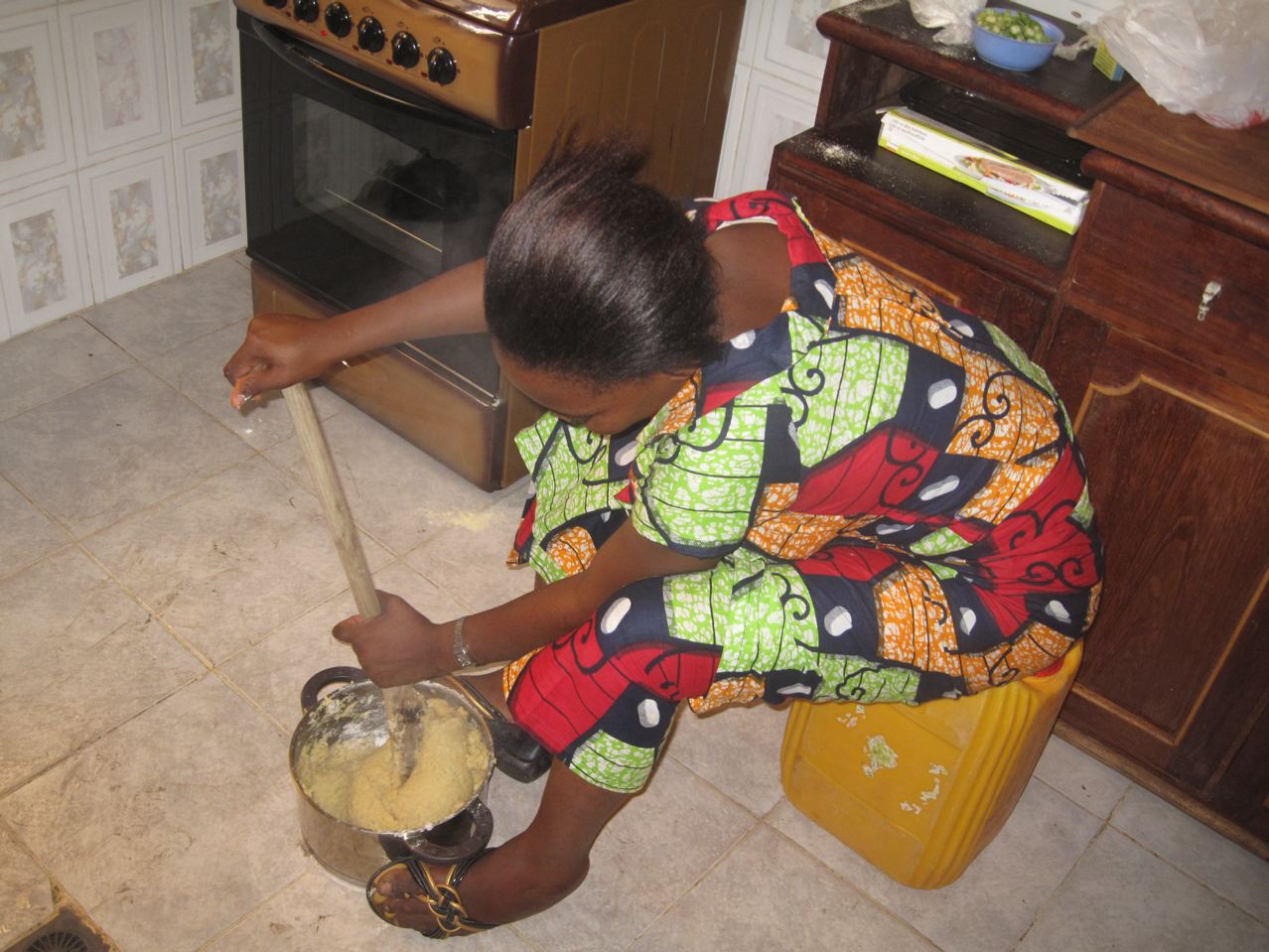
Today Sophie (the sister who buys food for us at the Marche and cleans the apartment) came early and cooked an African dinner for us.  Most of the locals eat only one meal each day: dinner.  And that dinner’s staple is “foo foo”.  [See our earlier blog or “google foo foo” for more information.]  Only one meal is eaten because the people here are very poor and have only money for one meal each day. 
Today Sophie bought the following with Wednesday’s 7000 Congolese franc (divide by 9 to approximate dollars) allotment for food: a few bananas; one papaya; 2 small, flat fish; some small onions; a few green onions (she calls them leeks); a little parsley type vegetable; a bag of okra; a small plastic bag of tomatoes, one sack of cassava flour; and one sack of corn flour.
From home she brought a wooden paddle (for mixing the “foo foo”) and a box of matches and charcoal (fuel in the hibachi outside) but miracles of miracles, we have had electricity all day.  Yesterday the power went out at 6:30 and came back at 17:00 (which is our normal routine).   


First she filled a pot with water (clean water from our pump and filter) and brought it to a boil while she cleaned the fish, which brought the cats.  Sister Ann chopped the tomatoes, greens, onions and okra. 


Corn flour with the knife used to clean the two small fish


Pouring cassava flower into the boiling water and corn flour mixture (no salt or seasonings)


Stir.  Using her wooden paddle, Sophie vigorously stirred the corn flour into the boiling water. 


Stir.  Placing the large pot on the floor between her feet, she then stirred in the cassava flour, making a stiff dough which reminded Sister Ann of “play dough”. It helps to put the feet around the pot and to sit on a water jug.


The finished meal.   The round ball of dough was then formed into softball-sized balls.  Sometime during this process the fish and vegetables were cooked.  The "foo foo" is like uncooked bread dough but Sophie's was not slimy


Wash the eating utinsels = the hands  Finally a bowl of water for washing hands was placed on the table and dinner was ready.


The eating is accomplished by trapping a morsel from the common bowl with a small ball rolled from the larger foo foo balls.
No plates, no utensils.  Just Adam’s fork.  With the right hand we each tore off pieces of “foo foo”, rolling it into small balls (still with our right hands) and dipped the ball into the fish/vegetable mixture.  Voila!  African sandwiches ! “piodi mulembua” (fish in okra) “bidia” (foo foo in the local Congolese language Tchiluba.) 

It was “ok” (small letters), less slimy than I had feared. 
Pluses: no utensils to wash and only the right hand dirty.  Sophie gave Sister Ann her stirring paddle and a small plactic bowl for making foo foo balls.
Minuses: the kitchen was a disaster!  But since it’s cleaning day I didn’t “get” to do the dishes today. 
We also “get” to have a cheese sandwich for lunch this evening. 

Elder William and Sister Ann Moore
PS  The two cats had foo foo slathered with leftover fish last night and ate most of it


Tuesday, July 5, 2011

Mbuji-Mayi Missionary Zone Conference


Diulu Branch Building -- unloading the lunch


Conference on the veranda because there was a water leak inside


Missionary Training: Two elders teach a father, President Packer is the blaring TV, the mother and child have not yet been invited to join


Elder Zafi from Madagascar


A picture of the group: 8 missionaries, President Packer and Sister Packer, Elder and Sister Moore,
Elder and Sister Kaelliker (Seventy from South Africa), and Elder Alfred Kyunga (Seventy from the Congo)
We hope this picture will show for you.


Sophie: She does our shopping in the Marche.  (Cheaper and safer for her to buy vegatables and fruits)  She also cleans 3 times a week.  She speaks passable English.  She had wanted to become a doctor and could have if financial circumstances weren't so dire.  While she was shopping in the Marche, she extended her  payment of less than a dollar and someone snatched the money from her hand. 

Sophie's family: 2 month old's name is Grady = Grace de Dieu (Grace of God)

Blog July 4th, 2011
June 30th is the Congo Independence Day, Independence from Belgium in the 60’s.  We were instructed to avoid crowds and to stay away from downtown Mbuji-Mayi and the celebration parade.  Downtown consists of a 2-lane road on the right and a 2-lane road on the left separated by a median and bordered by a very deep ditch.  Interestingly, both roads are marked to have traffic in both directions.  Our gardener Simba (means “twin” in the Bas-Congo dialect not “lion” as in Swahili) went to the parade and wished he hadn’t.  Huge crowd, packed like sardines.  He said some people fainted and were trampled and went to the hospital.  He said some were killed.  The park (???) across from Main Street was dotted with several hundred “widows” to day before.  We never understand the whys?
Last Tuesday was zone conference for our 8 missionaries.  Elder Koelliker (spelling) [2nd Quorum of Seventy from South Africa] had come to create the Laputa Stake and he taught the missionaries about the Holy Ghost and its importance in teaching.  I took him to the airport at 9 am while the conference continued.  Sister Moore had cooked 2 frozen chickens (from Brazil) and made delicious chicken salad sandwiches on short french breads.  Apples, cookies and Sprite rounded out the meal followed by cubed pineapple, the favorite. 
We love these missionaries and think that they are very handsome.  We have heard them teach with power.  One who has been here 9 months (since Mbuji-Mayi was opened to full time missionaries) has over 50 baptisms here.  The branches are filling all of their chairs so we expect more branch divisions in the near future. 
One interesting non-missionary experience involved a man Frere Bobo and I met in the alley coming from giving the missionaries their monthly living expenses.  We were on foot because President Packer had the truck in Laputa.  Most missionaries in the world use an ATM card.  Here the banking system is not reliable so the mission office wires money each month.  A man named Boaz recognized Frere Bobo then asked to visit me.  I set the appointment for Monday but he didn’t show.  Tuesday I found him at the gate after I had dropped Elder Koelliker and company off at the airport.  He was miffed because I had kept him waiting at the gate for 45 minutes.  Sister Ann (home alone fixing the missionary meal) wouldn’t answer his banging on the gate.  Simba wasn’t here yet.  This long story boils down to him being a “trafficker” and wanting to sell me “minerals” (diamonds, emeralds, gold, etc.), not wanting to know more about the Church.  “Just put them in your suitcase when you go home,” was his advice.  What a joke!  I have absolutely no interest in minerals.  August 2012 would find me in jail instead of attending my grandchildren’s baptisms. 
Next week we start teaching English to the members here and begin the temple preparation classes. 
Elder William and Sister Ann Moore

Sunday, June 26, 2011

Sunday at Dibindi Branch


Dibindi Branch is located down the long straight (narrow) road with washed out shoulders.  Lots of pedestrians and motocycles.  It is one of the 5 rented buildings in Mbuji-Mayi: 3 branches, one district office, and our mission office/home.
Pictured are classrooms and offices.


Pictured here is the Relief Society room (left) and the chapel (right).  Notice the newly planted flowers and the old engine block.


 Photo from inside the investigator Sunday School class looking out into the street.  Notice the narrow street and washed out shoulders, motorcycle taxi with one passenger, and drive way from the church. 


Inside the Investigator classroom before class started.  During class someone charged his/her cell phone from the wall plug. 


Check out the lesson outline that was covered in both French and Tsiluba.


Saturday found Sister Ann at work on her cross stitch project.  Notice the verrigated floss and the "dotted i".  On her iPod an Education Week talk.

26 June 2011
Dibindi Branch
Since our truck is in Laputa this weekend (for the creation of the new stake), President Jean Pierre Kalonji of the Dibindi Branch picked us up.  Good thing our street has a slight downhill since his battery was weak.  Today we attended the primary.  There were 22 children in attendance (from 2 years to 11 years old).  Many of the boys sported new haircuts: completely bald.  99.9% of Congolese men get haircuts at least every 2 weeks: bald.  For the first hour, a young elder taught the lesson on the 1st Article of Faith and various related topics: family home evening, going to the temple, family prayer.  In between repetitions of these topics, he asked various children to come up and lead the group in a song.  The only problem that surfaced came when a father tried to drop his very young son off in the chair next to us (white faces).  The young boy’s mother (Primary President) came in the 2nd hour so then he was fine.  Ann stayed for the 2nd hour that also had lots of repetition, as much a French lesson as a gospel lesson.  There are many people here in Mbuji-Mayi who don’t speak French. 
The investigator Sunday School class I attended the 2nd hour discussed “Judgment”, primarily in French but also in Tsiluba.  There I met Paul, Emile and Jonathan who were there investigating.  I offered the very tall (with a long beard) Paul my Bible so that he could read the scripture, but he declined saying that he needed glasses.  He tried mine, but they didn’t help.  Good lesson.  All of the lessons we’ve attended in the Congo are good, with discussion from the class members.  In two weeks, Elder Alfred Kilungu, the seventy from Kinshasa, will come with his wife to
in-service the primary.  This 22 member primary is small compared to Muya 1 Branch and Muya 2 Branch.  I’m hoping that the Primary can receive “top priority” here, instead of the Priesthood. 

Muya 2 (which meets from 11:20 – 2:20) has a lower primary attendance now than last year when it was on the “early schedule” since some children are too tired to attend.  It seems that malnutrition makes people tired.  Most people here don’t eat but one meal a day: dinner.  No breakfast, no lunch, just dinner.  It’s the 2nd poorest country in the world.  Transportation is another problem.  How can a family with 8 children all afford to come to church.  The only forms of transportation here are by motorcycle taxi (driver + one or two behind) or by foot.  One sister in Muya 2 walks one hour in each direction to attend. 

There were about 120 people (men, women and children) in attendance for the one hour Sacrament Meeting (60-70% attendance). The choir opened followed by greetings (French and Tsiluba) and all six verses of the opening congregational hymn.  The young man who taught the 1st hour of Primary led the music.  Branch business followed and then the Sacrament hymn and distribution of the Sacrament.  The reverence is very good, even among the small children.  Restless babies and hungry small children are pacified in place by their mothers.  I wonder it that would work in our DayBreak 8th ward? 

Everyone treats us like gold.  They are pleased that Sister Ann is now speaking a little French.  They also enjoy using their little English.  Next week we will begin teaching English to the members.  There is a lot of interest.  We’ll get to really know the members.  Classes will be held in two buildings since we have transportation and the members don’t.  Also soon the preparations for a District temple trip will begin.  We have reservations in Johannesburg for the 3rd week in August 2012 (the last week of our mission) for 20-25 members.    We remember the groups that came to the Hong Kong Temple from foreign countries. 

Hope that this gives you a little idea how the Church works here.  Really very similar to any other unit anywhere else in the world.  The Primary does need more emphasis here. 

Elder William and Sister Ann Moore

Thursday, June 23, 2011

Johnny Lingo -- The Dark Side

People in our lives:

 Frere Aaron:  He has dreams of temples and keys (like Michael Wilcox's story).  He is an artist and is helping us find African art to bring home.

 President Bobo Ephraim: President of the Muya 2 Branch.  He works part-time for the Church in Mbuji-Mayi, knows everyone and moves the works along.  When the young missionary in Mweni-Ditu was arrested because his visa was irregular, Frere Bobo got him out.  When we go to the airport to pick up someone, Frere Bobo gets us into the closest parking lot, without paying the $10 parking fee.


Yves, the young elder awaiting his mission call.  Notice the yellow "helping hands" vest.  Yesterday he washed out 10 yellow, empty peanut oil jugs so we could have a storage of water.   


Simba the gardiner.  Last night he helped a friend find the right blood type for a 2 month old baby.  A willing student was found and the blood sold for not 15000 francs but 10000 francs ($11).

Blog: 22 June 2011
Johnny Lingo – The Dark Side
A brother from one of the branches here in Mbuji-Mayi visited yesterday.  Just wanted to talk.  Two years ago his missionary papers were rejected because he was too old (26) but his younger brother is now on a mission in Kinshasa.  He is now a branch missionary and regularly proselytes in a village 30 kilometers from the Muya building.  He says there are 25 members in the village and more who are interested.  When he couldn’t go on a mission, he decided to get married but ran into another roadblock: “la dotation” (dowry).  His future father-in-law (not a member of the Church) wants $400 plus 2 goats for his daughter’s hand.  One of the goats is for a wedding party to be hosted by the future mother-in-law.  Here there is a great desire to get married in the temple, but that is almost impossible due to the great expenses of travel and necessary visas. 
It’s a tradition in the Congo and throughout Africa that husbands have to pay a dowry to the bride’s family.  [It was in one of the #1 Woman Detective Agency books.]  Elder Oaks spoke out against “la dote” on one of his visits here and called upon the Church members to break that tradition.  La Dote keeps LDS young people from marrying.  Other Congolese just live together in common-law relationships.  I counseled the 28-year old to prayerfully speak with his future father-in-law about the advantages of getting married over not getting married.  Maybe the Lord will soften his heart and the hearts of other family members.   Of interest is one of the benefits of the Communist regime in China: the breaking down of traditions.  Chinese women are now treated with a degree of equality.
The promise of Alma 24:14 seems appropriate for the Saints in Mbuji-Mayi.  How else will they be able to stand?
14 And I will also ease the burdens which are put upon your shoulders, that even you cannot feel them upon your backs, even while you are in bondage; and this will I do that ye may stand as witnesses for me hereafter, and that ye many know of a surety that I, the Lord God, do visit my people in their afflictions.
I spoke to a brother in one of the branches last Sunday.  He has 12 children with one presently on a mission.  His salary with a government job is $50 per month.  The brother who led the investigator class discussion in Sunday School is one of the 2 returned missionaries in Mbuji-Mayi.  He’s been home for 2 years and hasn’t yet found employment.  He asked if I had employment for him at my home.  I don’t know how these families live. 
Ann shared the following with two of our visitors: the Book of Mormon as a type of Christ. The brother who has dreams was moved to tears.  Our future missionary, recently converted from Islam, took furious notes.
Book of Mormon, a Type of Christ
[07PGP#01

The Book of Mormon bore witness of its own divinity by the manner it came forth. 

*The Book of Mormon - Typifies of Christ
A. Book of Mormon   A'. Jesus Christ
A.  Coming forth declared by an angel
B.  Came to restore in time of apostasy
C.  Ushered in a new dispensation
D.  Laid away in a stone receptacle
E.  Taken from receptacle by Joseph Smith /Joseph of Aramathea
F.  Came forth after stone rolled away
G.  Angel oversees coming forth
H.  First one to see plates (Joseph Smith) forbidden to touch
    First one to see Christ (Mary) forbidden to touch
I.  Gold (most precious metal) never loses its brightness
I.  Christ (most precious being) never loses His brightness
J.  Attested to by twelve witnesses
K.  The Word of God
L.  Teaches fullness of Gospel
M.  Keystone of our religion
     Cornerstone of the Church
N.  Speaks again after coming forth from the ground or  
     grave (Moroni 10:27)
O.  Received by the poor and meek (Isaiah 29:18)
P.  Opens spiritual eyes and ears (Isaiah 29:18)
    (Matthew 13:16-17)
Q.  Brings understanding and doctrine (Isaiah 29:24)
R.  Taken away to be revealed again
S.  To return again to reveal all things (2 Nephi 27:11) (D&C 101:32)
T.  Causes children of Jacob to sanctity the Holy One of Jacob (Isaiah 29:23)
     Christ is the Holy One of Jacob (2 Nephi 25:29)
*Notes from Brother Norman’s class

The mission president arrives tomorrow with 2 Area Seventies.  They will travel to Laputa to organize a stake.  Despite the burdens and difficulties here, the Lord has His eyes on these Congo Saints. 

Elder and Sister Moore


Friday, June 17, 2011

Coming Home from Church

There are 4 big branches in Mbuji-Mayi with the imminent possibility of new branches being formed.  Last Sunday in the branch of Muya 1, some children sat on the concrete floor due to a dearth of chairs.  I counted about 10 remaining sacrament cups as 4 deacons finished passing the water.  (Do the math: 36X4 = 144)  Eight full time missionaries have been here for about 2 months and the work is progressing at a heightened pace.
(A note: Last Sunday Elder Affi from Ivory Coast had his appendix removed in a small hospital (clinic) here.  The doctor was very competent and the facilities simple and clean.  The total cost: $487.  Elder Affi will probably leave the hospital tomorrow, Saturday.  The other 7 elders have taken turns being his companion so that the missionary work in the various sectors of the city hasn’t been noticeably affected.)
On the way home after the meetings, Sister Ann snapped a few photos. 

This is a typical, leased building for church meetings.  Mbuji-Mayi plans to buy a piece of property soon for a future stake center.


Across the street from the Muya 1/Muya2 building is construction for a water runoff ditch.  This major street, named after a martyr, is scheduled for paving. "Wait and see" is the finish date.
Street scenes heading home.


A house with a neat yard

The main street leading to the center of town 
The side street leading to the 8 missionaries' house 
 Typical street scene: a bicycle laden with charcoal, an old battered car passing, and missing in this photo are the myriads of motorbikes used as taxis beeping their horns
The backyard evangelical church meeting next door.  Group prayers begin about 5 a.m. in the dark, everyone praying outloud at the same time (in Tsiluba, not French).  Later there are preachers, often young men gesticulating with their arms and speaking loudly.  The worshippers give frequent oral responses. 
Sister Ann found this Brigham Young quote in “The 3 Pillars of Zion” by Larry Barkdull.  It fits the situation here in Mbuji-Mayi.  The 2½ million people here are without work and hungry, yet they won’t exert themselves to farm this rich soil, preferring to extend their hands for money or to scratch the earth for diamonds. 
     Concerning Zion, Brigham Young said: “We will not wait for angels or Enoch and his company to come and build Zion, but we are going to built it.  We will raise our wheat, build our houses, fence our farms, plant our vineyards and orchards and produce everything that will make our bodies comfortable and happy and in this way we intend to buildup Zion on the earth and purify it and cleanse it from all pollutions.
     If we cease to hold fellowship with that which is corrupt and establish the Zion of God in our hearts and in our houses, in our cities and throughout our country, we shall ultimately overcome the earth, for we are the Lords of the earth and instead of thorns and thistles, every useful plant that is good for the food of man and to beautify and adorn, will spring from its bosom.
[We more fully appreciate what the Saints have accomplished after living in the Congo for 3 months.]
Sister Ann also likened the city of Mbuji-Mayi to The Parable of the Great Supper (Luke 14: 16-24)
16 The said he unto him, A certain man made a great supper, and bade many:
17 And sent his servant at super time to say to them that were bidden, Come; for all things are now ready. [Restoration?]
18 And they all with one consent began to make excuse.  The first said unto him, I have bought a piece of ground and I must needs go and see it: I pray thee have me excused.
19 And another said, I have bought five yoke of oxen, and I go to prove them: I pray thee have me excused. [Serve mammon rather than God]
20 And another said, I have married a wife, and therefore I cannot come. [Reminds one of time before the Flood]
21 So that servant came, and shewed his lord these things.  Then the master of the house being angry said to his servant, Go out quickly into the streets and lanes of the city, and bring in hither the poor, and the maimed, and the halt, and the blind.
22 And the servant said, Lord, it is done as thou hast commanded, and yet there is room.
23 And the lord said unto the servant, Go out into the highways and hedges, and compel them to come in, that my house may be filled. [Hedges = GR hedged pathways] [Compel = GR urge]
24 For I say unto you, That none of those men which were bidden shall taste of my supper. [Taste Eternal Life]
The Gospel is being preached to the very by-ways of the Earth, and with great success.  Surely this is a sign that the 2nd Coming is close.  Last month a stake of Zion was organized in the neighboring city of Kananga.  (a distance of 15 minutes by air, 2 days by road from Mbuji-Mayi – check out a map)  Next week the city of Laputa (no electricity and poor roads) be become a stake of Zion.  Mbuji-Mayi is projected to become a stake of Zion in a year.  The 2 Congos will have 10 stakes.  Russia has one.  Belgium has one.  The days of the Gentiles are waning. 
Elder William and Sister Ann Moore